
Some things in life are worth waiting for. Machu Picchu turned out to be one of them – though it tested our patience in more ways than one. This trip was a long time in the making. It was originally planned for last winter break, delayed by job interviews, and then pushed to this upcoming winter – until a last-minute decision had us booking flights for the summer instead. And after all that planning, you’d think the hardest part would be getting there.
Spoiler: It wasn’t.
When we finally arrived, Machu Picchu decided to play hide-and-seek in a think blanket of fog, leaving us waiting – again – for hours before the view we’d dreamed of revealed itself. And yet, despite all the delays and the misty frustration, I can say without hesitation – it was worth it.
But I think I’m getting ahead of myself…
Before heading to Machu Picchu, we spent a couple of incredible days exploring Cusco and the surrounding Sacred Valley. We had originally planned to stay in Ollantaytambo for a few nights, but with only a week in Peru, there just wasn’t enough time. Still, we made our way there anyway, as it’s the departure point for the train to Machu Picchu.
Ollantaytambo itself is more than just a train stop – it’s a charming town rich in history and surrounded by Inca ruins. Perhaps in the future we’ll be able to explore the archaeological site, enjoy the cobblestone streets and local markets, and take in the beauty of the Sacred Valley at a slower pace.
We left Cusco by bus (technically there is a train station 25 minutes by taxi from Cusco’s city center, but the departure times were less convenient) and traveled on the same roads that had previously taken us to Chinchero. This time, however, we got to make a few stops along the way.
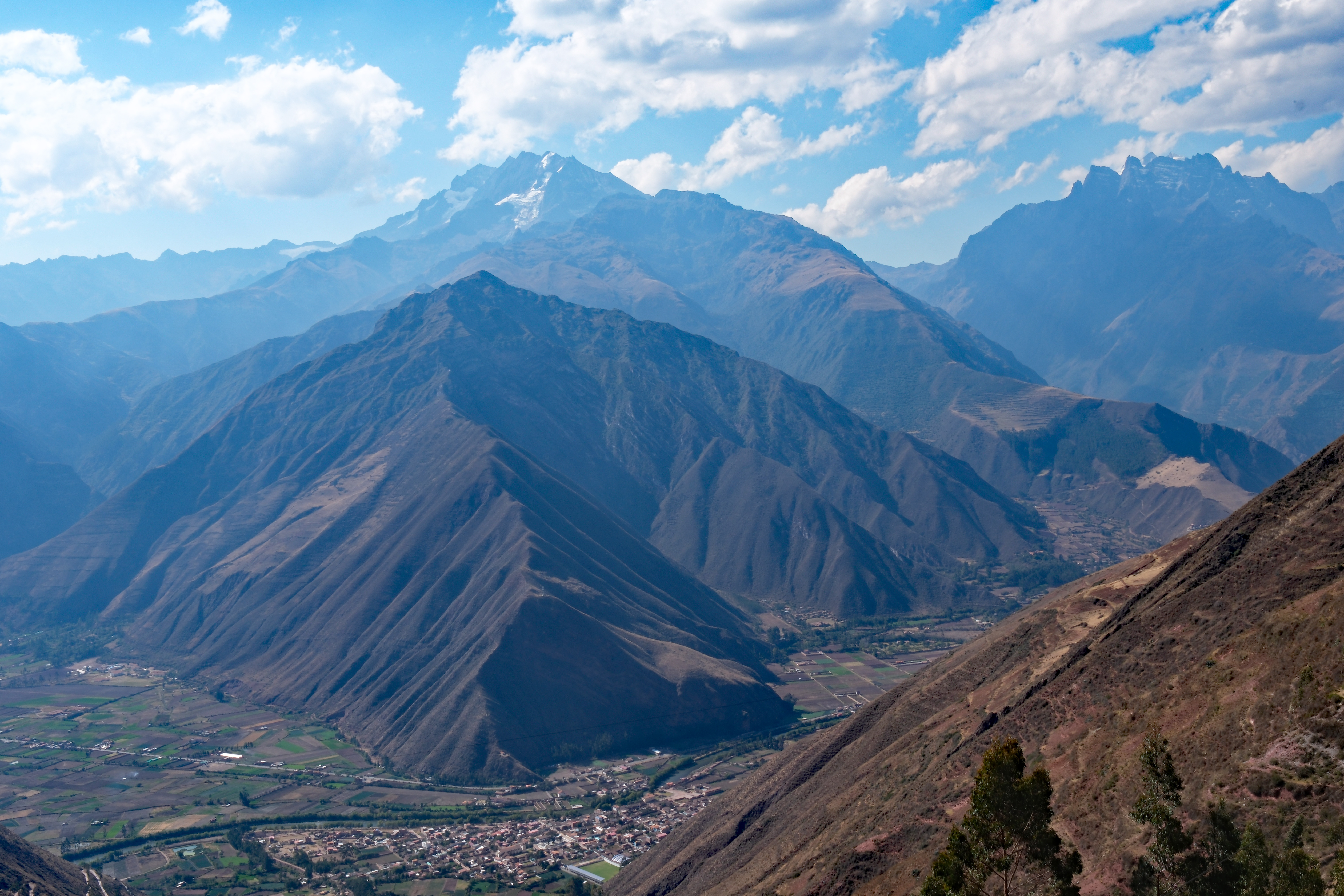

Two hours later, we found ourselves just outside the train station of Ollantaytambo. We had planned to take PeruRail, having been established in 1999. However, for reasons unknown, we had been unable to book online tickets in advance (perhaps it was just a temporary glitch), so we opted for Inca Rail instead. Not exactly new to the scene, they’ve been in operation since 2010, and each tier offers comfort and scenic viewing.
Boarding went smoothly and we were on our way to Aguas Calientes, the town at the base of Machu Picchu. We arrived after sunset, but had no problem finding our hotel. Unbeknownst to us, the hotel had sent someone to the train station to meet us – believe me when I tell you that everything connected to Machu Picchu is a well-oiled machine. Everyone is there to make sure you experience everything you’re hoping to and Hotel El Mapi was no exception.
After dinner at Green House, we wandered through the town a bit. We knew we wouldn’t be out late since our Machu Picchu tickets were for 6am (since we’d booked a bit last minute, the more reasonable 7am, 8am, and 9am tickets had sold out).
We mostly encountered restaurants, cafes, bars, convenience stores, and souvenir shops. The base of town is along the river and has some lovely lookout areas, whereas at top of the stairs, we were surprised to find hot springs. Guess we didn’t do our research so well after all, or perhaps since neither of us has much interest in hot springs, we merely skipped over them.
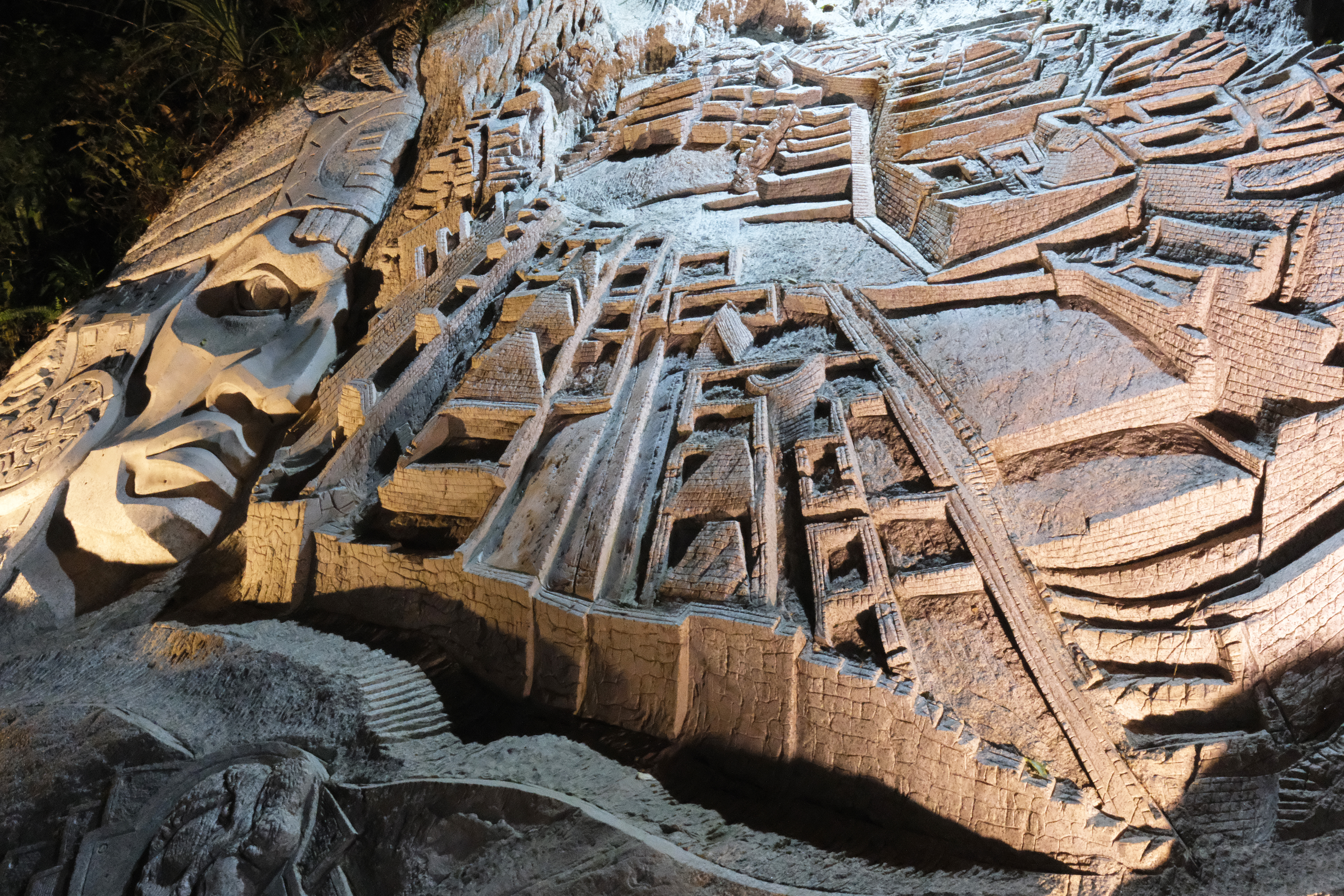
After photographing the following carving, we made our way back to the hotel and called it a night.
Here’s the part where I admit that despite the fact that visiting Machu Picchu was a dream of mine, we were a bit lazy. Breakfast at our hotel started at 5am, but we had read that you should board the buses up to Machu Picchu an hour before your arrival time. We decided to risk it and started the morning with breakfast!
I’m so glad we did. We ate quickly, packed up our gear, and made it to buses by 5:30am. The ticket people were surprised to see us, because they were already boarding people with 7am tickets, but we got on the next bus and made it to the top just minutes after 6am.
Our first job was to find a restroom, because we’d been warned that once you enter the ticketed area of Machu Picchu, there are no restrooms until you exit again.
That turned out to be true, but we’d also been given some information that was clearly false. We’d been told that in order to enter Machu Picchu you needed two things: A ticket and a guide. But we’d talked to a friend that had gone after the requirement had been announced and he said that it wasn’t enforced. So we took our second risk of the day and arrived without a guide (figuring we’d hire one on the spot if we really needed to).
While most people had guides, there were definitely others like us visiting the grounds independently. This ended up being a blessing and a curse for us – I’d say 85/15.
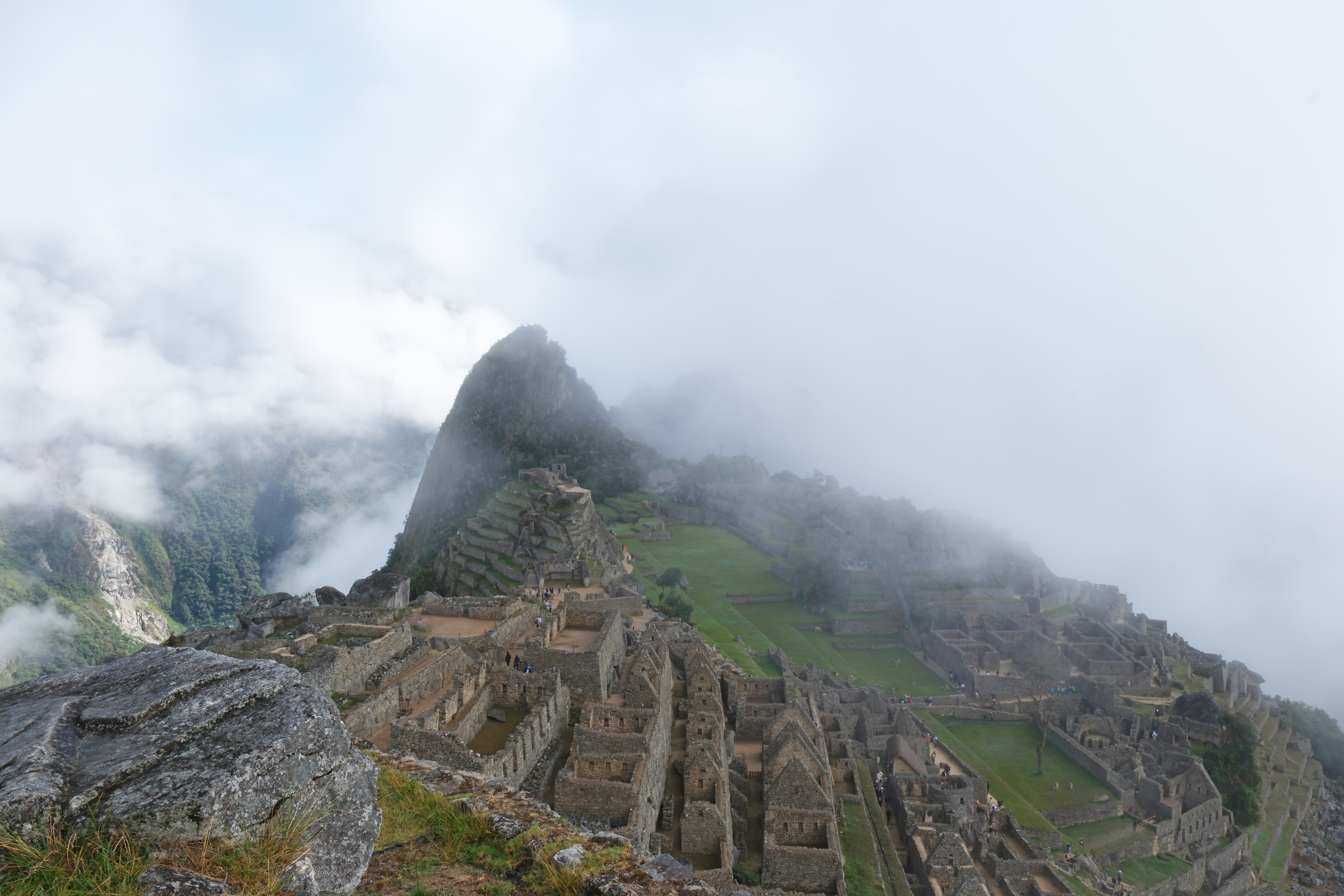
While driving up earlier that morning, we’d been surprised by the thick fog surrounding us. We’d hoped that when the sun rose, the fog would dissipate, but so far, that hadn’t happened.
I had done my research, so I knew that when we arrived, the first thing we would see is the epic shot of Machu Picchu down below. Instead, we saw this:

Without a guide, Chandler tried to confirm what I thought I knew, but Google Maps was only working so-so. According to the map, it was unclear if we were in the right spot or not. Meanwhile, instead of watching the fog roll away, it began to mist – incredibly unusual behavior for July. Chandler and I backtracked a bit and stood under some trees for protection to wait it out. We’d brought umbrellas, but many of the guides didn’t like us using them (despite the fact that we were nowhere near any ruins).
We hung out talking for an hour before making our way back to the viewpoint. By this point, there was a sizable crowd as the 6am and 7am ticket holders had all arrived. From listening to other groups it became clear that we were waiting at the right spot – but waiting for how long? And how long would we be able to wait, knowing there was no accessible restrooms?
Another hour passed and our numbers tripled. The only people to leave the viewpoint and enter the ruins were ones with guides who had to stick to a timetable. Some of them would be hiking Huayna Picchu, Machu Picchu Mountain, or Huchuy Picchu and they needed to start on time. Others said goodbye to their guides at the viewpoint, unwilling to leave, but recognizing that after two hours, their guides needed to be able to pick up their next groups.
Hour three came and went and finally we could start to see some sunlight through the fog. There was audible cheering and dancing, but just like that it was gone.
It took three and a half hours of waiting to finally get the view below – and by that point, it felt like the most beautiful thing I had ever seen.
With hundreds of people arriving every hour, there were well over 1,000 of us at the viewpoint. Which meant taking that iconic photo of yourself with the ruins down below was never going to happen. You’d be trampled and have everyone’s legs in your photo! I guess we could have waited for everyone to go through, but that would have likely taken a few more hours (and did I mention the lack of restrooms!).
Meanwhile, the day got clearer and brighter and you could feel everyone’s joy. For most people, Machu Picchu is a once in a lifetime trip – and just like everyone else, we’d been worried we’d picked the worst possible day. Turns out, Machu Picchu was worth the wait.

Something we hadn’t anticipated in all our stressing about the fog – but that seemed so obvious when we overheard a guide saying it – was that Machu Picchu was empty. In fact, he said it was the emptiest he’d ever seen it – and he’d been guiding tours there for a decade.
Instead of the hundreds to thousands of people you’d typically see down below, we had a few dozen. Most of us were up on the viewing platform and it was absolutely spectacular.
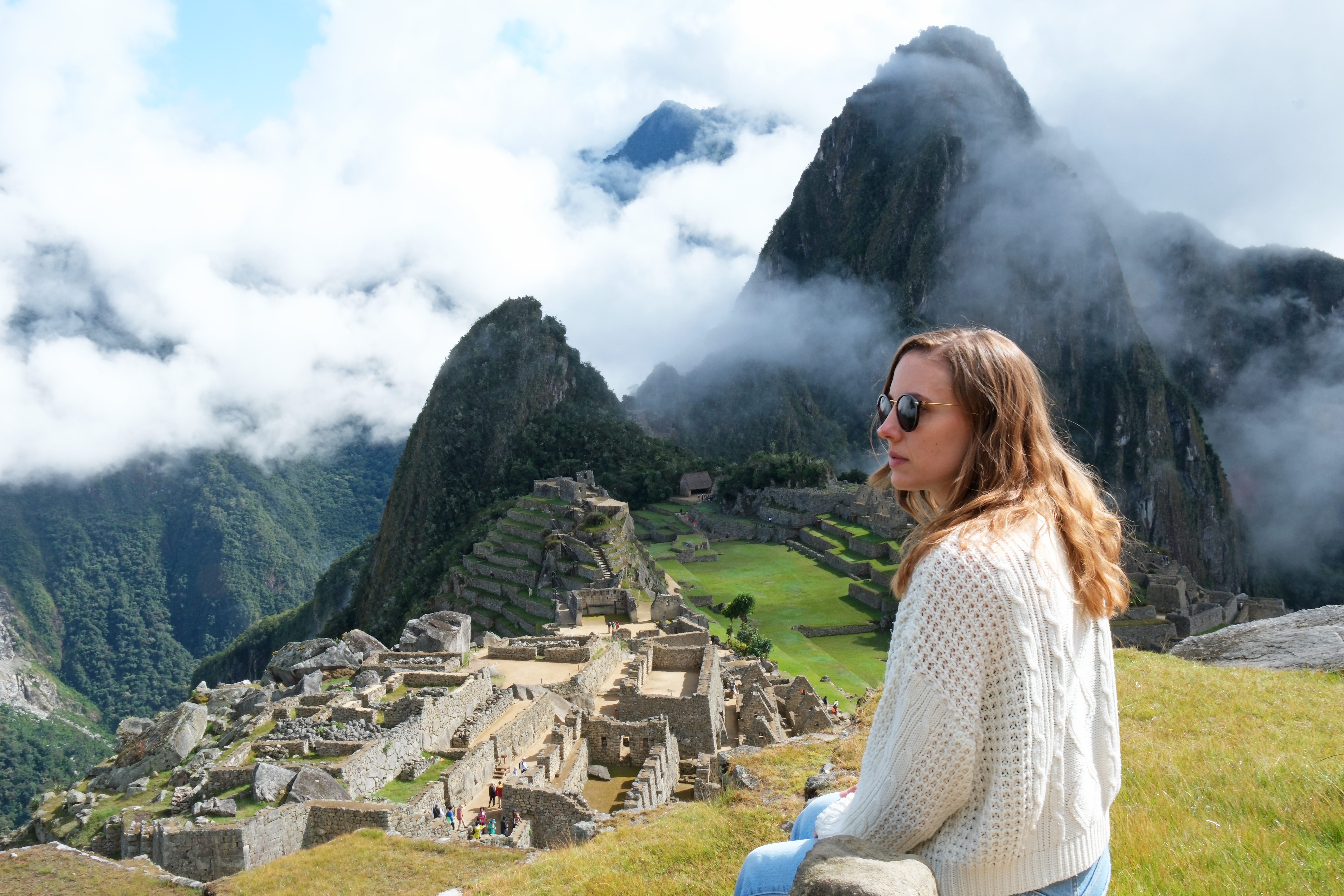
In the meantime, I was still trying to figure out where to get a photo of me + Machu Picchu. We chose to move down and to the left (whereas the staircase into the ruins goes right). It wasn’t what I had previously imagined, but after a morning of fog, it more than exceeded my expectations!
With the photo taken care of, it was time to visit the ruins up close and personal. We were so grateful to have been early arrivers and to have stayed near the front, because while everyone else was crowding to take their dream Machu Picchu photos, we made it down the staircase.
I turned around for a quick shot of the crowd we left behind!

Now, time for some fun facts about Machu Picchu:
-It was built by the Inca Emperor Pachacuti around 1450
-Abandoned during the Spanish conquest in the 1530s
-“Rediscovered” by the outside world by Hiram Bingham in 1911 (local Indigenous communities had been using it as farmland)
-Machu Picchu had an advanced irrigation system and terraced fields (just like Moray) that allowed the Incas to grow food to sustain its population
-It’s estimated that only 750 people lived in Machu Picchu at any given time and that it was likely reserved for elite members of the society
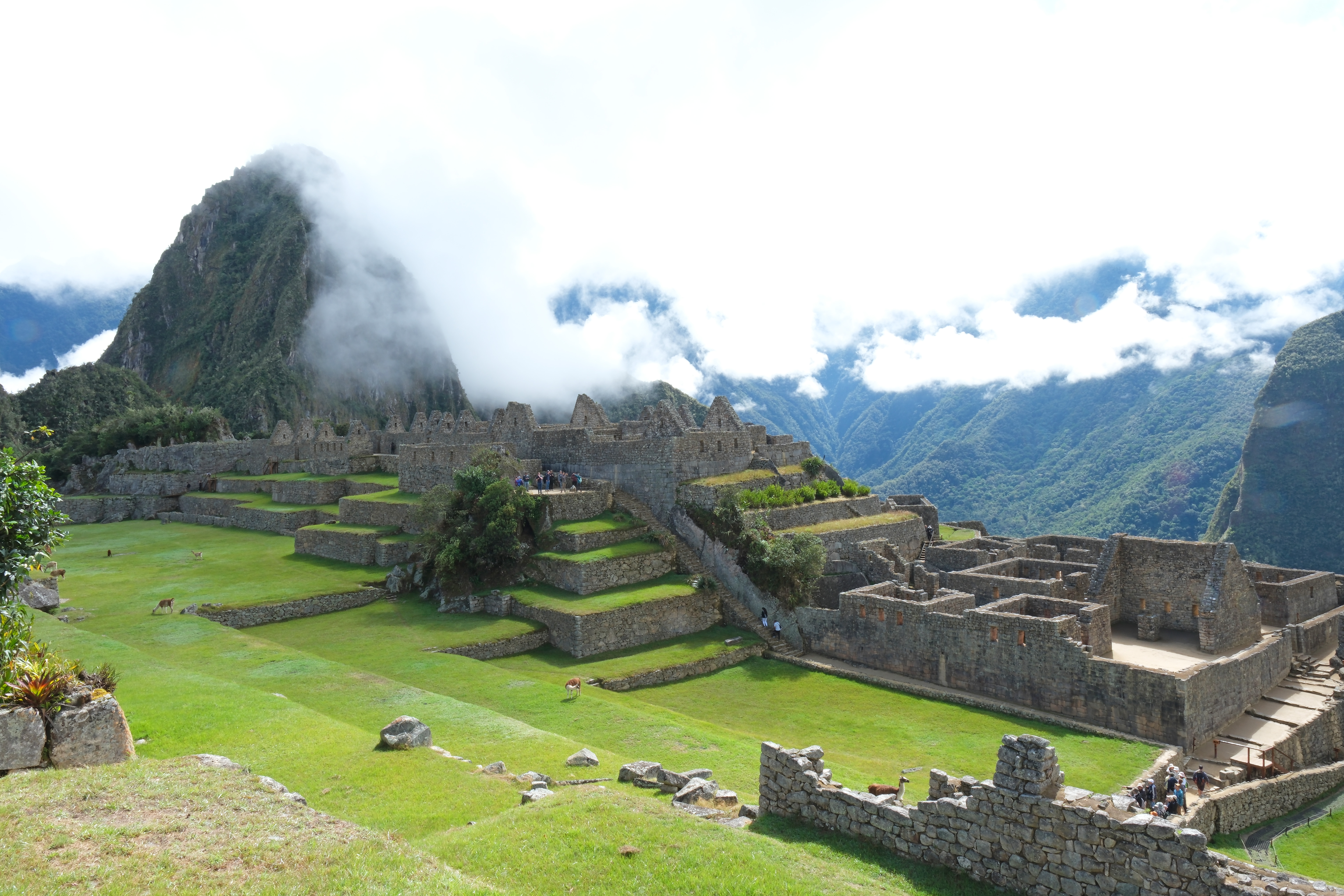
The ruins are a testament to Inca engineering, with structures that have withstood centuries of earthquakes. The trapezoidal shapes of windows and doors, as well as the inward-leaning walls, prevent collapse. The stonework uses a method called ashlar masonry, where stones are cut to fit together without mortar.
Also, nearly 60% of Machu Picchu’s construction is underground! There’s an intricate network of drainage channels and foundations that manage rainwater efficiently.

But of course, photos of Machu Picchu (or Peru in general) aren’t complete without llamas! Wild llamas are allowed to freely roam throughout Machu Picchu. That said, they aren’t just there for tourists like me to fawn over – they also mow the grass.
And they aren’t the only wildlife known to inhabit Machu Picchu. During the pandemic, with tourism numbers significantly decreased, spectacled bears were spotted wandering around the ruins.
These bears, also known as Andean bears, are the only bear species native to South America and are classified as “vulnerable” on the International Union for Conservation of Nature’s Red List.
That was not news that Chandler needed to hear. However, with up to 5,600 tourists daily, the bears didn’t stick around for long!
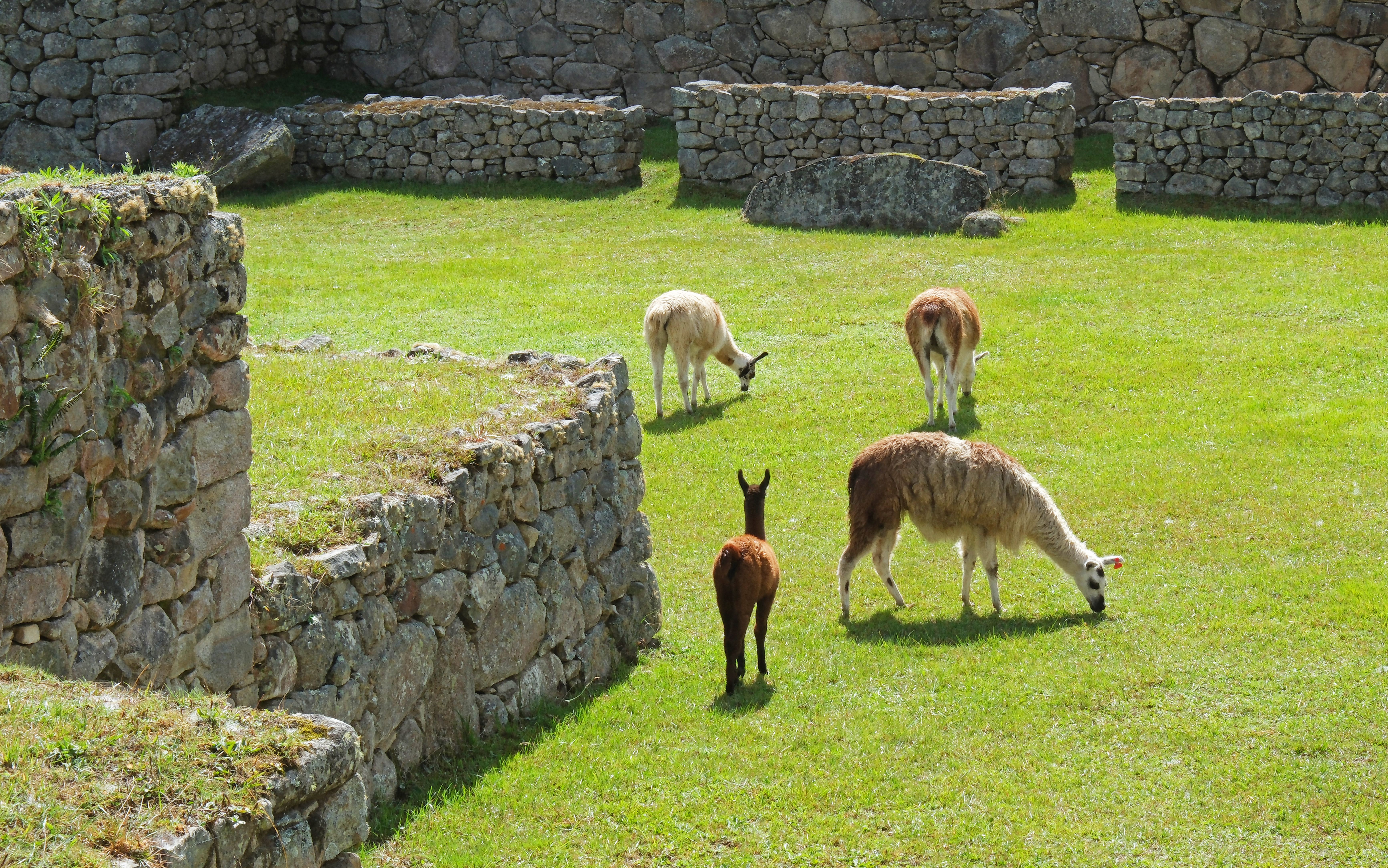
The Incas built Machu Picchu to blend seamlessly into its natural surroundings. In fact, some rocks were left in place and incorporated into structures, emphasizing harmony with nature.
The site is surrounded by sacred peaks, including Huayna Picchu and Machu Picchu Mountain, which were considered spiritual protectors. Today, you can hike either mountain, as well as Huchuy Picchu (which means “Little Mountain”).
All of the mountain hikes require an additional permit. Chandler and I had considered it, but with the weather, I’m so glad we didn’t. It was a hard call though. I would absolutely have loved to stay a second day and do one of the hikes, but I didn’t want to rely on someone else’s timetable for our only day at Machu Picchu.

In fact, many people choose to visit Machu Picchu via an even longer hike – the Inca Trail. Once we were back in Cusco, we met a mother and daughter who had just completed the Inca Trail. Five days without a shower or bed didn’t sound like an ideal trip to me – and they seemed incredibly grateful to be finished.
But for some, it’s the only way to visit Machu Picchu . We were than happy with our bus-train-bus combo!
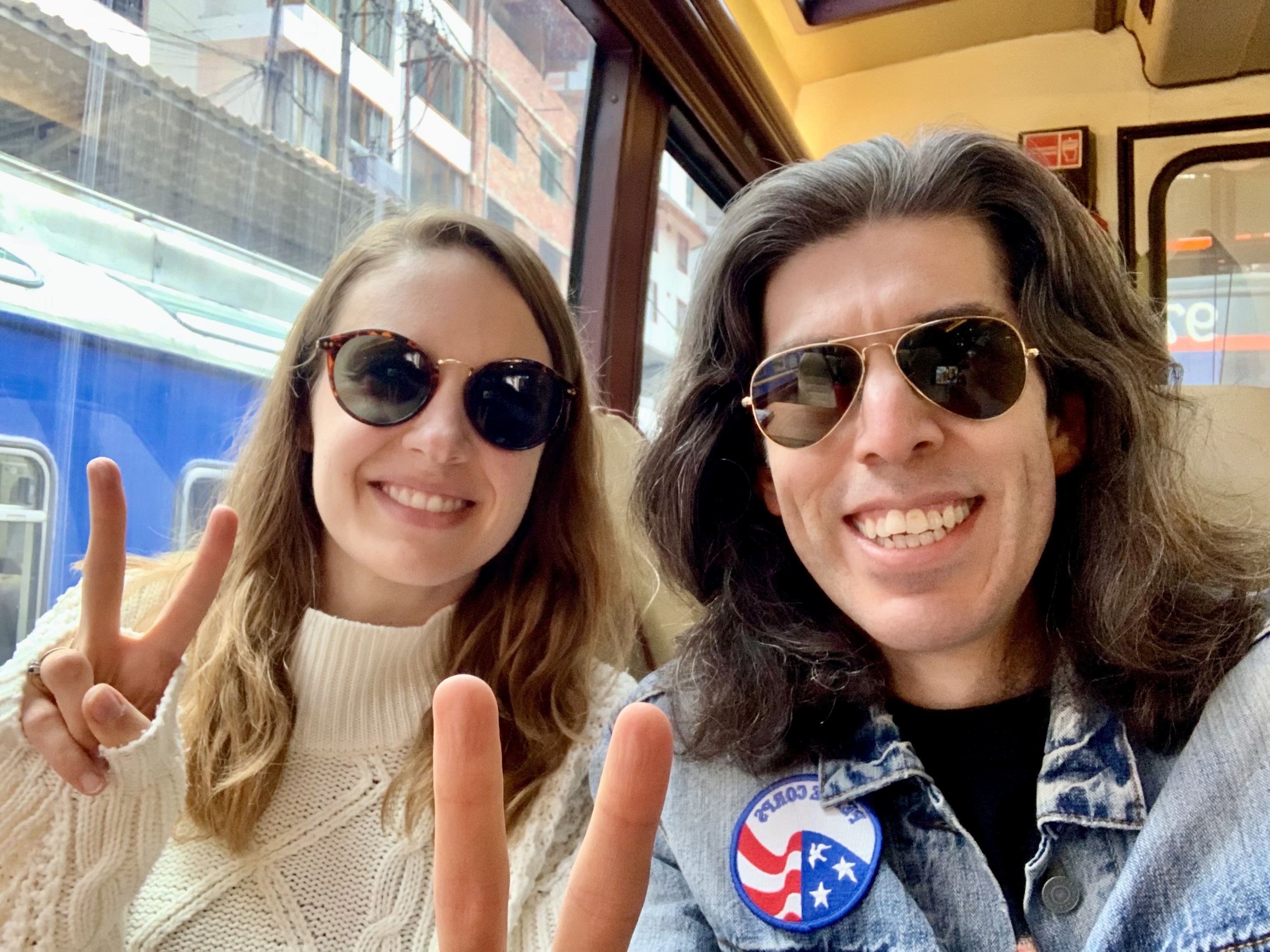
After all that lead-up – the planning, the waiting, and fog – our time at Machu Picchu seemed to pass in a flash. But I have to admit, our time in Peru – and the memories we made – were nothing short of spectacular.
Another incredible UNESCO World Heritage Site checked off our bucket list! And Machu Picchu is one of about 40 sites to be recognized for both its cultural and natural significance. Guess that means we get ✓✓
 Abroad With Ashley