We struck out from Taormina fairly early because we had a packed day ahead of us. We’d be stopping at a number of historical sites before staying in Cefalù for the night.
Our first excursion was Villa Romana del Casale – a Roman luxury villa near the town of Piazza Armerina that was built in the late 3rd or early 4th century CE, likely as a private retreat for an elite Roman official or noble. The layout is designed around a central peristyle courtyard, meaning it has an open garden area surrounded by a covered walkway, which is supported by a series of columns. The symmetry was considered aesthetically pleasing, while the open-air space allowed natural light and ventilation to flow into the surrounding rooms.
In the 12th century, a mudslide buried the villa, inadvertently preserving its structures and mosaics. It was rediscovered and excavated in the 20th century and became a UNESCO World Heritage Site in 1997 for its extensive and unparalleled collection of Roman mosaics (which is why we had made the trek!).

My favorite mosaic is titled “Bikini Girls.” It depicts young women dressed in what looks like modern bikinis, engaged in various athletic activities, such as weightlifting, discus throwing, and running.
I love it because it just goes to show that humanity never really changes – we’ve always loved babes in bikinis. And to have a room-sized mosaic takes so much more dedication than simply hanging up a poster or calendar.

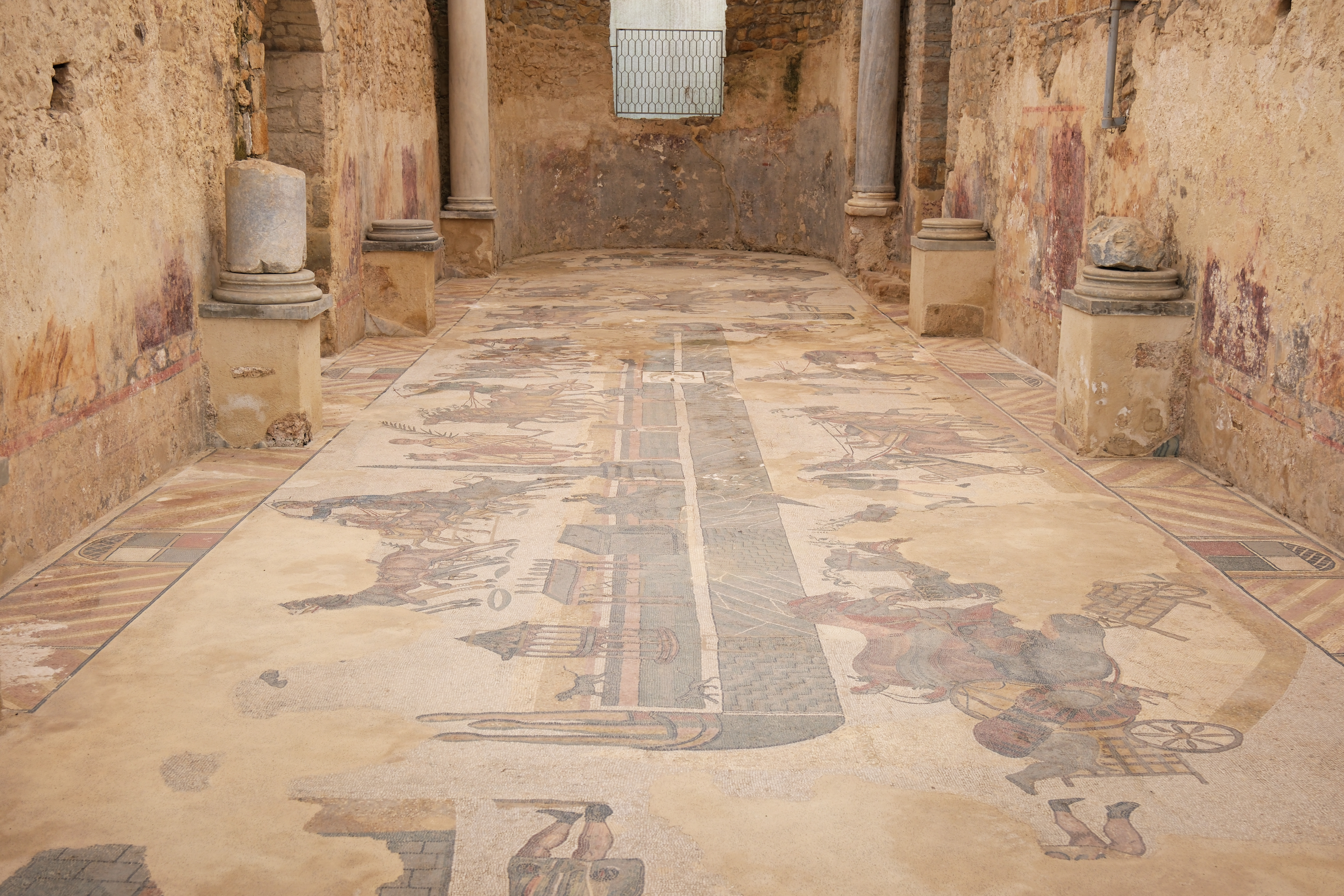
But the real show stopper is a sprawling mosaic called “The Great Hunt.” Over 60 meters long, the corridor features exotic animals, such as lions, elephants, and tigers – hinting at the global reach of the Roman Empire. In some of the scenes, the animals are depicted as being captured and transported, likely to games or private zoos. But I also loved the ones where the animals bite back – literally.
The mosaics in the villa cover over 3,500 square meters, making it one of the largest collections in the world.


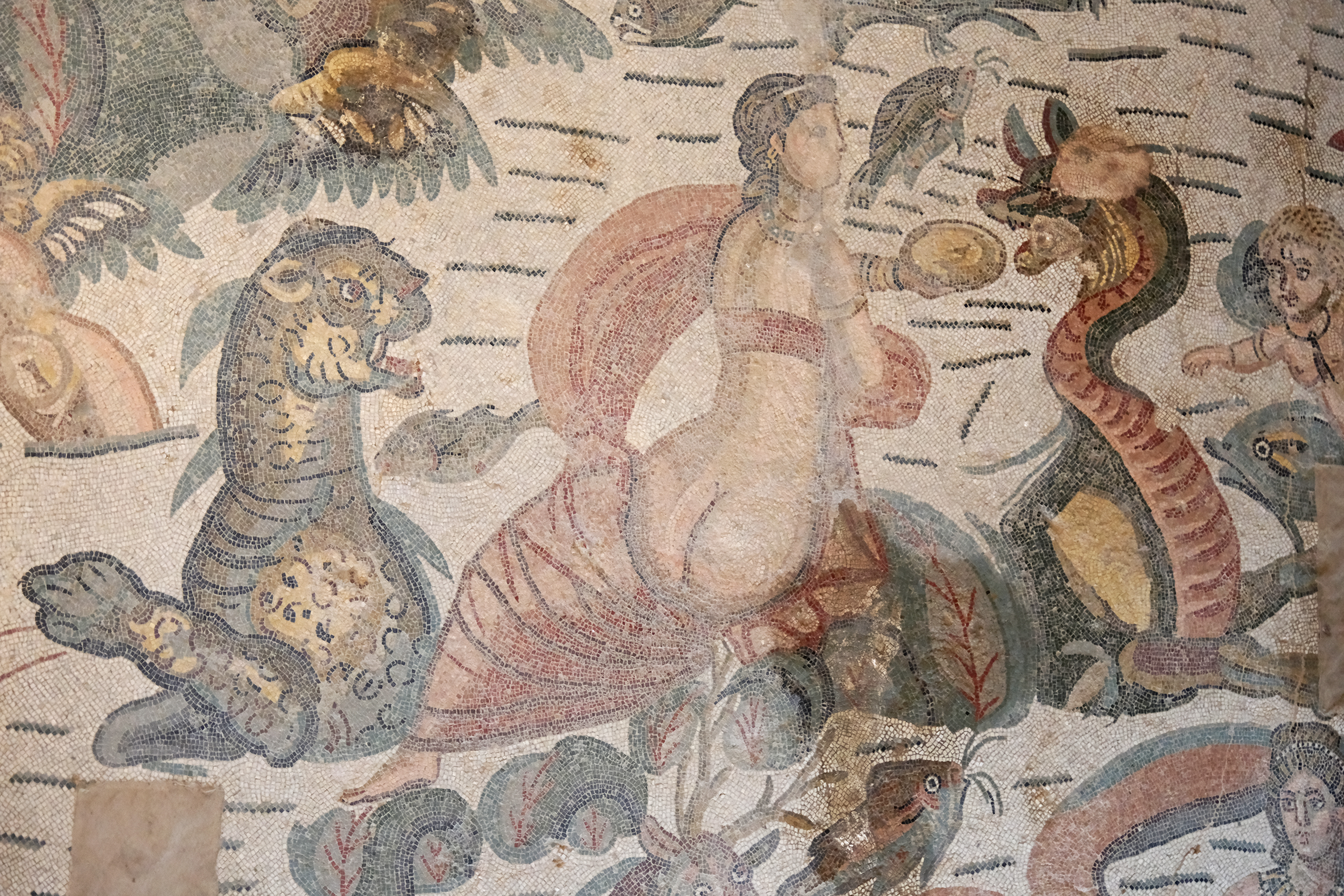
Other rooms are adorned with mosaics depicting mythological stories, such as Hercules and the Twelve Labors, as well as Odysseus’ adventures.
The villa also showcases sophisticated Roman engineering, with features like underfloor heating systems (hypocausts) in the baths.
And, once again, we’re reminded of just how basic humanity is – with a love of mythological creatures and women with big booties.
We probably spent about an hour at the villa. Despite its size, it can get pretty packed with tourists, but we were able to weave in and out of the larger groups, spending more time at our favorite mosaics and skipping quickly past the ones that didn’t hold our attention.
Afterward, we hit the road again. The villa had been about a two-hour drive from Taormina. Now we had an hour-and-a-half drive to Valle dei Templi (Valley of the Temples). The Valle dei Templi is also a UNESCO World Heritage Site. In the 1990s, UNESCO focused on recognizing cultural sites that represented unique aspects of human achievement across different periods.
Sicily’s Greek and Roman legacies stood out during the evaluation process, leading both the villa and the valley to be designated in the same year. The Valle dei Templi is located near Agrigento, originally known as Akragas, which was founded by Greek settlers around 580 BCE. Akragas peaked in the 5th century BCE, when the temples were built and the population exceeded 200,000.
However, in 406 BCE, the city was sacked by the Carthaginians and later came under Roman control in 210 BCE. Despite being occupied by the Romans, Vandals, Byzantines, and Arabs, its significance waned, and much of the site was abandoned.
It was rediscovered in modern times, with major excavations and restorations beginning in the 18th century. Today, it’s a stunning testament to ancient Greek architecture and urban planning.
The temples are spread out along a ridge that’s about 2.5 kilometers long. The temple of Juno is at one end, while the Temple of Castor and Pollux is toward the opposite end and that’s where we started. We had made our way to a fairly large parking lot, then we walked up, purchased our tickets, and we were in the park.

All that remains of the Temple of Castor and Pollux are the four pillars above, yet it’s a picturesque spot to start your walking tour. The majority of people in the park were on foot, but a few had opted to take a tram and there were some teenagers on a scooter tour.
Walking between the Temple of Castor and Pollux and the Temple of Heracles, we passed countless scattered stones – silent remnants of ancient Akragas. Some were the foundations of the agora, where citizens once traded and debated, while others were fragments of altars or the Sacred Way, where processions moved between the temples. From this spot, you can also take in stunning views of modern Agrigento, its buildings perched on the hills in the distance.

One of my favorite sites in this area is a partially reconstructed Telamon from the Temple of Zeus. Of course, they were likely painted in vibrant colors. Before visiting Egypt in 2018, I struggled to picture ancient sculptures and temples painted in bright, vivid colors. Then we visited the Temple of Khnum in Esna, with its stunningly preserved colors.
Tucked nine meters below the modern street level, the temple’s vibrant reds, blues, and yellows survived for centuries, giving a rare glimpse of what these ancient works must have looked like in their prime. It made me wonder how similarly vivid the Telamons at the Temple of Zeus might have been when they were first created.

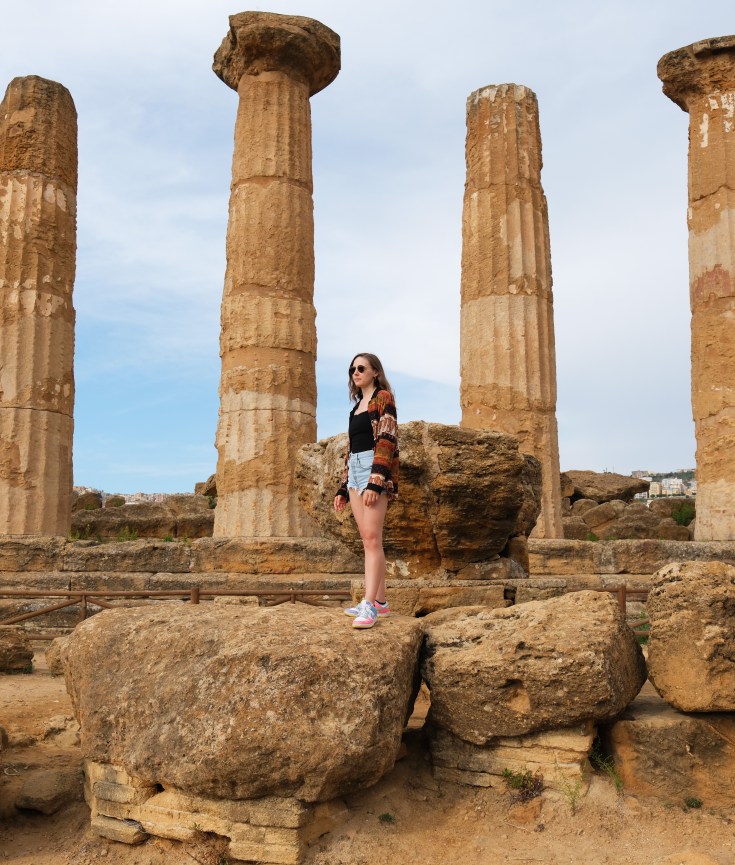
We continued on to my actual favorite spot – the Temple of Heracles (and not just because I loved the Disney movie Hercules as a child! Also, am I deeply concerned about the upcoming live action? I am. Susan Egan was the perfect Meg).
This is the oldest temple in the valley, dating to around 510 BCE. Only eight columns remain standing, but that’s probably what I love about the area.

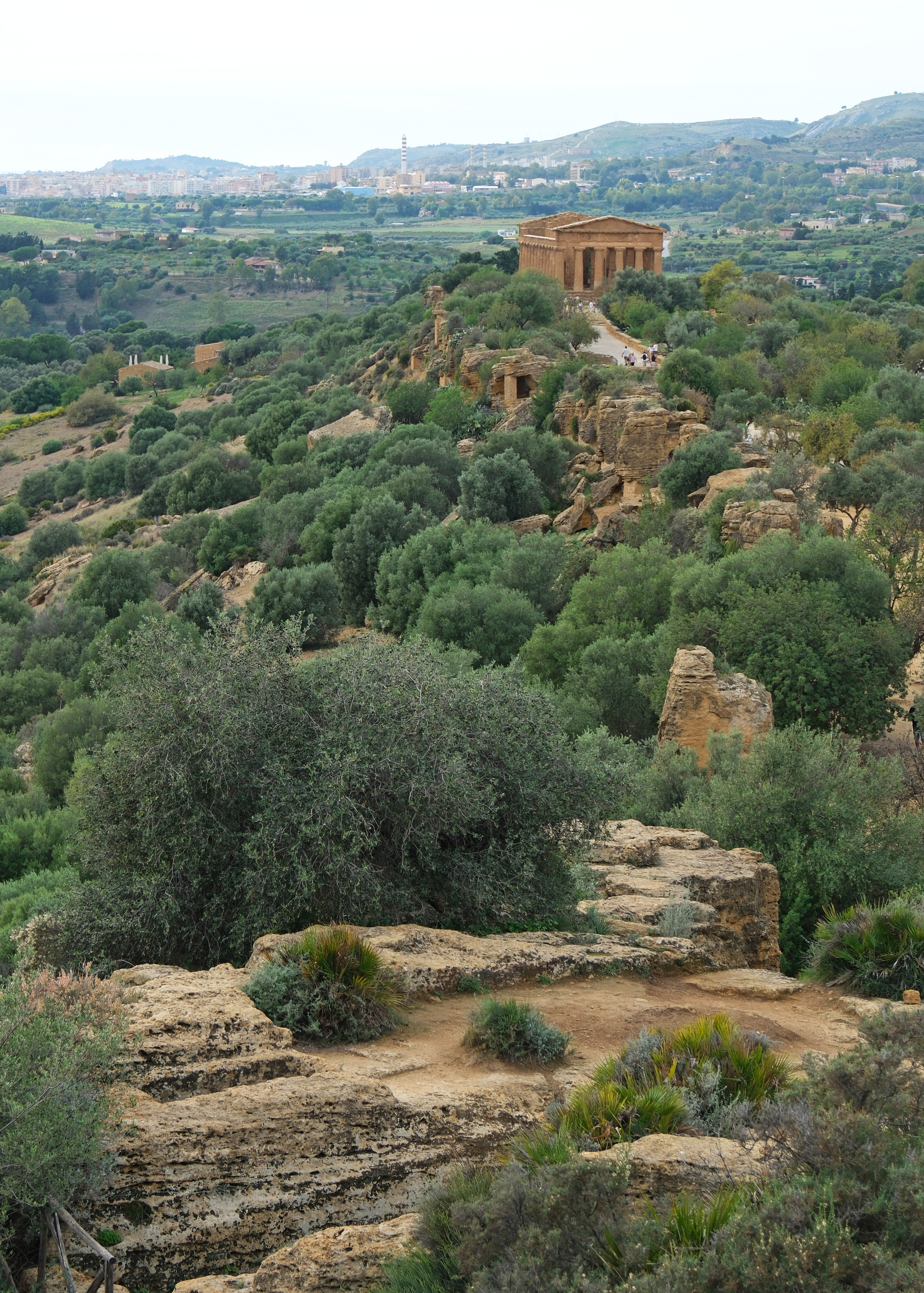
Next up was the Temple of Concordia. It’s considered one of the best-preserved Greek temples in the world, thanks to its conversion into a Christian basilica in the 6th century CE, which saved it from destruction.
I probably stood around this temple for the longest, waiting for people to pass by so that I could get the photo below. The valley wasn’t packed and we had plenty of moments to ourselves, but this was definitely the busiest site, with people, understandably, walking around on all four sides.

With that, we made our way to the Temple of Juno. It’s located on a high ridge with spectacular views of the surrounding area.
It was partially destroyed by the Carthaginians in 406 BCE, reminding us why we can’t have nice things.

At this point, many visitors choose to shuttle back to the start. But with one final drive left of the day, we decided to stay on our feet a bit longer.
Though we spent a lot of time walking between the temples, the paths gave us space to take in the scale of the valley and the quiet beauty of the surrounding olive groves.
Plus, we got one last gorgeous look at the Temple of Concordia.
We arrived at Alberi del Paradiso just after sunset, exhausted from navigating some of the narrowest streets we’ve ever driven on. Our initial impression of the hotel room was a bit underwhelming – it was quite dark, and the decor felt dated. But as we settled in, we began to notice everything the hotel had to offer. Dinner that night was simple but incredibly fresh, with pasta tasting like it could have been made by someone’s nonna.
The next morning, the breakfast completely won us over, offering a wide and varied spread that left nothing to be desired. They even had a juicer for Chandler to make fresh carrot juice. The gardens surrounding the property were stunning, and the morning light transformed the space entirely. In the end, it turned out to be the perfect base for our time in Cefalù.
From Alberi del Paradiso, the walk down to Cefalù’s old town takes you through a network of stone staircases and winding pathways, weaving between gardens, quiet residential areas, and glimpses of the town below. Before long, we had stunning views of the sea and rooftops that seem to cascade toward the waterfront – even with the overcast weather.

The beach was mainly deserted for two reasons: First, it was October and while the weather was absolutely perfect for a stroll, it was decidedly too chilly for a swim. Second, there was a rather large film crew shooting something for an Italian teen audience.
We made our way to the main attraction: The maze of cobblestone streets, ancient buildings, and hidden courtyards of old town. Cefalù is the kind of small town that seems straight out of a postcard, with its medieval streets winding toward a golden crescent of beach.
If you stick to the main streets, you’ll likely miss its true charm. The magic lies in the narrow, winding alleys, where laundry flutters overhead, locals chat from balconies, and you stumble upon hidden courtyards and tiny trattorias. Exploring off the beaten path is where Cefalù reveals its most authentic and delightful surprises.

But both the main street and side streets have wonderful opportunities for shopping – in fact, you might say we were surprised to shop until we dropped!
It started with a colorful pair of earrings at Donna Pidda, a jewelry and accessory line that is handmade, inspired by the traditional icons, vibrant colors, and rich folklore of Sicily. Following the theme of handmade with local designs, we also purchased a vase from Ceramiche La Maga and had a lovely conversation with one of the artists.
The shop that we had the most fun in? Sarama Design. I wanted to buy the cactus canvas photographed below – alas it was too large. So we settled for a t-shirt and magnet instead. But I loved the bold colors and funky designs!


It wasn’t just the shopping that made Cefalù lovely: The architecture and decor are stunning. The Cefalù Cathedral with the Rocca in the background is an incredible sight. We had debated hiking up the Rocca di Cefalù but decided this was a trip for slowing down and relaxing. And even without the panoramic views, there was plenty to see.
Some personal favorites were the teal door and the staircase of beautifully painted flower pots photographed below.


We also had an abundance of food, drink, and snack options! The juices at Zagara Juice Bar looked incredible and if we’d had more time, we were 100% interested in Kalapinta, the first independent tap room in Cefalù.
Instead, our eyes were set on Bastione & Costanza, a literary cafe known for its slow food and pizza. Not only are they a plastic-free business, they have an ethical and sustainable approach – they supply their kitchen with garden fresh herbs and vegetables, all grown in the Ciaculli countryside. The gardens are tended and harvested daily by the agronomists of Coltiviamo Tradizioni farm. Typically, they also carry lactose-free cheese, but they were out that day. Chandler was still able to choose from a surprisingly long list of vegan pizzas.
I opted for their pistachio pizza and then I spent the next two hours trying to eat all of it. It was divine. We also sampled some of their own wine, as well as olive oil – with their incredibly fresh bread. This is a restaurant we could have returned to again and again.

We needed to walk off the pizza and so we wandered further out from the old town. It was there that we found these fantastically colorful tiled steps. I couldn’t even tell you which street they were on, but each step was a different, bold pattern and if we ever have a staircase in a future home, I’m drawing my inspiration from these!


After our walk, we decided that we’d never be hungry enough for a proper dinner. Instead, I picked up my daily gelato, this time at Sapore di Sale Gelateria. If I remember correctly, I indulged in pistachio and an incredibly rich dark chocolate.
We also picked up some persimmons and other fruits at a local produce vendor to snack on later in the evening.
I can absolutely understand why people fall in love with Cefalù – we’d had a perfect day. But we were more than ready to make our way to the final destination of our trip: Palermo!
 Abroad With Ashley